Sunday, August 23, 2020

JOURNEY TO UNDERWATER ......

In the world there are many place to go, also there are some places were we cant' go. Example like seas and ocean. we can't go such places with out suits[not for long time . Such places we can go with a vehicle like rocket, submarine etc....


JOURNEY TO UNDERWATER......


submarine (or sub) is a watercraft capable of independent operation underwater. It differs from a submersible, which has more limited underwater capability. It is also sometimes used historically or colloquially to refer to remotely operated vehicles and robots, as well as medium-sized or smaller vessels, such as the midget submarine and the wet sub. Submarines are referred to as "boats" rather than "ships" irrespective of their size.


 On September 7, 1776, during the Revolutionary war, the American submersible craft Turtle attempts to attach a time bomb to the hull of British Admiral Richard Howe’s flagship Eagle in New York Harbor. It was the first use of a submarine in warfare.

Submarines were first built by Dutch inventor Cornelius van Drebel in the early 17th century, but it was not until 150 years later that they were first used in naval combat. David Bushnell, an American inventor, began building underwater mines while a student at Yale University. Deciding that a submarine would be the best means of delivering his mines in warfare, he built an eight-foot-long wooden submersible that was christened the Turtle for its shape. Large enough to accommodate one operator, the submarine was entirely hand-powered. Lead ballast kept the craft balanced.

Donated to the Patriot cause after the outbreak of war with Britain in 1775, Ezra Lee piloted the craft unnoticed out to the 64-gun HMS Eagle in New York Harbor on September 7, 1776. As Lee worked to anchor a time bomb to the hull, he could see British seamen on the deck above, but they failed to notice the strange craft below the surface. Lee had almost secured the bomb when his boring tools failed to penetrate a layer of iron sheathing. He retreated, and the bomb exploded nearby, causing no harm to either the Eagle or the Turtle.

During the next week, the Turtle made several more attempts to sink British ships on the Hudson River, but each time it failed, owing to the operator’s lack of skill. Only Bushnell was really able to competently execute the submarine’s complicated functions, but because of his physical frailty he was unable to pilot the Turtle in any of its combat missions. During the Battle of Fort Lee, the Turtle was lost when the American sloop transporting it was sunk by the British.

Saturday, August 22, 2020

ATOMIC NUCLEAR FUSION

There is no earth, if fusion is not present. Every part of the object in the world goes with nuclear fusion . All the particle is made of matter, the tiny particle of matter is called atoms . The atoms goes with the process of nuclear fusion........

NUCLEAR FUSION

Government to invest £220m in nuclear fusion plant concept | E&T ...

 It is a nuclear process, where energy is produced by smashing together light atoms. It is the opposite reaction of fission, where heavy isotopes are split apart. Fusion is the process by which the sun and other stars generate light and heat.

It’s most easily achieved on Earth by combining two isotopes of hydrogen: deuterium and tritium. Hydrogen is the lightest of all the elements, being made up of a single proton and a electron. Deuterium has an extra neutron in its nucleus; it can replace one of the hydrogen atoms in H20 to make what is called “heavy water.” Tritium has two extra neutrons, and is therefore three times as heavy as hydrogen. In a fusion cycle, tritium and deuterium are combined and result in the formation of helium, the next heaviest element in the Periodic Table, and the release of a free neutron.

Deuterium is found one part per 6,500 in ordinary seawater, and is therefore globally available, eliminating the problem of unequal geographical distribution of fuel resources. This means that there will be fuel for fusion as long as there is water on the planet


Let’s take look at a fusion reaction. You can see that as deuterium and tritium fuse together, their component parts are recombined into a helium atom and a fast neutron. As the two heavy isotopes are reassembled into a helium atom, you have ‘extra’ mass leftover which is converted into the kinetic energy of the neutron, according to Einstein’s formula: E=mc2.

For a nuclear fusion reaction to occur, it is necessary to bring two nuclei so close that nuclear forces become active and glue the nuclei together. Nuclear forces are small-distance forces and have to act against the electrostatic forces where positively charged nuclei repel each other. This is the reason nuclear fusion reactions occur mostly in high density, high temperature environment.


At very high temperatures, electrons are stripped from atomic nuclei to form a plasma (ionized gas). Under such conditions, the repulsive electrostatic forces that keep positively charged nuclei apart can be overcome, and the nuclei of select light elements can be brought together to fuse and form other elements. Nuclear fusion of light elements releases vast amounts of energy and is the fundamental energy-producing process in stars.

The goal of fusion research is to confine fusion ions at high enough temperatures and pressures and for a long enough time to fuse.


Fusion reactions between light elements, like fission reactions that split heavy elements, release energy because of a key feature of nuclear matter called the binding energy, which can be released through fusion or fission. The binding energy of the nucleus is a measure of the efficiency with which its constituent nucleons are bound together. Take, for example, an element with Z protons and N neutrons in its nucleus. The element’s atomic wieght A is Z + N, and its atomic number is Z. The binding energy B is the energy associated with the mass difference between the Z protons and N neutrons considered separately and the nucleons bound together (Z + N) in a nucleus of mass M. The formula isB = (Zmp + Nmn − M)c2,where mp and mn are the proton and neutron masses and c is the speed of  light .    It has been determined experimentally that the binding energy per nucleon is a maximum of about 1.4 10−12 joule at an atomic mass number of approximately 60—that is, approximately the atomic mass number of iron. Accordingly, the fusion of elements lighter than iron or the splitting of heavier ones generally leads to a net release of energy.


THANKS FOR READING.........😎😎

Friday, August 21, 2020

THE RAYS OF ELECTROMAGNETIC RADIATION ........


There are some amazing ray, which is a traveling of light waves in a straight line in any variation. There are  lot of dangerous rays which can destroy the whole universe. In that lot of rays, there is a ray called gamma ray or gamma radiation wave. It is a one of the  power full ray that can give a end the universe......


THE GAMMA RAY

 A gamma ray (gis a packet of electromagnetic energy [photon] emitted by the nucleus of some radionucluies following radioactive decay. Gamma photons are the most energetic photons in the electromagnetic spectrum.

Gamma ray - Wikipedia

Gamma rays are a form of electromagnetic radiation[EMR] . They are the similar to X-rays, distinguished only by the fact that they are emitted from an excited nucleus. Electromagnetic radiation can be described in terms of a stream of photons, which are mass less particles each travelling in a wave-like pattern and moving at the speed of light. Each photon contains a certain amount (or bundle) of energy, and all electromagnetic radiation consists of these photons. Gamma-ray photons have the highest energy in the [EMR] spectrum and their waves have the shortest wavelength.

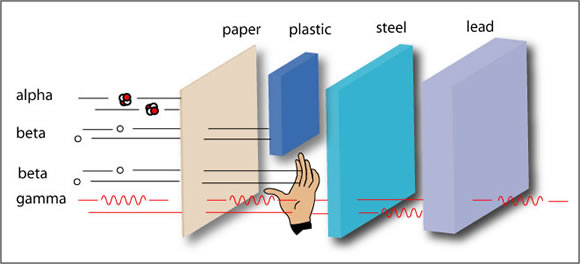
Scientists measure the energy of photons in electron volts (eV). X-ray photons have energies in the range 100 eV to 100,000 eV (or 100 keV). Gamma-ray photons generally have energies greater than 100 keV. For comparison, ultraviolet radiation has energy that falls in the range from a few electron volts to about 100 eV and does not have enough energy to be classified as ionising radiation. The high energy of gamma rays enables them to pass through many kinds of materials, including human tissue. Very dense materials, such as lead, are commonly used as shielding to slow or stop gamma rays.


Gamma-ray bursts are the most energetic and luminous electromagnetic events since the Big Bang and can release more energy in 10 seconds than our Sun will emit in its entire 10-billion-year expected lifetime! Gamma-ray astronomy presents unique opportunities to explore these exotic objects. By exploring the universe at these high energies, scientists can search for new physics, testing theories and performing experiments that are not possible in Earth-bound laboratories.

If we could see gamma rays, the night sky would look strange and unfamiliar. The familiar view of constantly shining constellations would be replaced by ever-changing bursts of high-energy gamma radiation that last fractions of a second to minutes, popping like cosmic flashbulbs, momentarily dominating the gamma-ray sky and then fading.

NASA's Swift satellite recorded the gamma-ray blast caused by a black hole being born 12.8 billion light years away (below). This object is among the most distant objects ever detected.


THANKS FOR READING.......😎😎


Thursday, August 20, 2020

THE RAY OF HEAT.................

The ray of the way from the sun travel in a straight line,were billions of ray fall on the earth.If we show a magnification lens in the way of the ray light of the sun, which produces heat. by using for burning a whole paper as a example. 


LASER RAYS.........

laser is a device that emits light through a process of optical amplification based on the stimulated emission of electromagnetic radiation. The term "laser" originated as an acronym for "light amplification by stimulated emission of radiation".

Laser - Wikipedia

The laser is an outgrowth of a suggestion made by Albert Einstein in 1916 that under the proper circumstances atoms could release excess energy as light—either spontaneously or when stimulated by light. German physicist Rudolf Walther Ladenburg first observed stimulated emission in 1928, although at the time it seemed to have no practical use

In 1951 Charles H. Townes, then at Colombia university in New York City , thought of a way to generate stimulated emission at microwave frequencies. At the end of 1953, he demonstrated a working device that focused “excited”  ammonia molecules in a resonant microwave cavity, where they emitted a pure microwave frequency. Townes named the device a maser, for “microwave amplification by the stimulated emission of radiation.” Aleksandr Mikhaylovich Prokhorov and Nikolay Gennadiyevich Basov of the P.N. Lebedev Physical Institute in Moscow independently described the theory of maser operation. For their work all three shared the 1964 Nobel Prize for Physics.

An intense burst of maser research followed in the mid-1950s, but masers found only a limited range of applications as low-noise microwave amplifiers and atomic clocks. In 1957 Townes proposed to his brother-in-law and former postdoctoral student at Columbia University, Arthur L. Schawlow (then at Bell Laboratories), that they try to extend maser action to the much shorter wavelengths of infrared or visible light. Townes also had discussions with a graduate student at Columbia University, Gordon Gould, who quickly developed the maser” in a seminal paper in the December 15, 1958, issue of Physical Review. Meanwhile, Gould coined the word laser and wrote a patent application. Whether Townes or Gould should be credited as the “inventor” of the laser thus became a matter of intense debate and led to years of litigation. Eventually, Gould received a series of four patents starting in 1977 that earned him millions of dollars in royalties


The Townes-Schawlow proposal led several groups to try building a laser. The Gould proposal became the basis of a classified military contract. Success came first to theoder h r maimna, who took a different approach at Hughes Research Laboratories in Malibu, California. He fired bright pulses from a photographer’s flash lamp to excite chromium atoms in a crystal of synthetic ruby, a material he chose because he had studied carefully how it absorbed and emitted light and calculated that it should work as a laser. On May 16, 1960, he produced red pulses from a ruby rod about the size of a fingertip. In December 1960 Ali Javan, William Bennett, Jr., and Donald Herriott at Bell Labs built the first gas laser, which generated a continuous infrared beam from a mixture of helium and neon. In 1962 Robert N. Hall and coworkers at the General Electric Research and Development Center in Schenectady, New York, made the first semiconductor laser


While lasers quickly caught the public imagination, perhaps for their similarity to the “heat rays” of science fiction, practical applications took years to develop. A young physicist named Irnee D’Haenens, while working with Maiman on the ruby laser, joked that the device was “a solution looking for a problem,” and the line lingered in the laser community for many years. Townes and Schawlow had expected laser beams to be used in basic research and to send signals through air or space. Gould envisioned more powerful beams capable of cutting and drilling many materials. A key early success came in late 1963 when two researchers at the University of Michigan, Emmett Leith and Juris Upatnieks, used lasers to make the first three-dimensional holograms 

Helium-neon lasers were the first lasers with broad commercial applications. Because they could be adjusted to generate a visible red beam instead of an infrared beam, they found immediate use projecting straight lines for alignment, surveying, construction, and irrigation. Soon eye surgeons were using pulses from ruby lasers to weld detached retinas back in place without cutting into the eye. The first large-scale application for lasers was the laser scanner for automated checkout in supermarkets, which was developed in the mid-1970s and became common a few years later. Compact disc audio players and laser printers for personal computers soon followed.

Lasers have become standard tools in diverse applications. Laser pointers highlight presentation points in lecture halls, and laser target designators guide smart bombs to their targets. Lasers weld razor blades, write patterns on objects on production lines without touching them, remove unwanted hair, and bleach tattoos. Laser rangefinders in space probes profiled the surfaces of Mars and the asteroid Eros in unprecedented detail. In the laboratory, lasers have helped physicists to cool atoms to within a tiny fraction of a degree of absolute zero.


THANKS FOR READING.......😎😎


THE EXPLORATION OF "HYDROGEN"

In the world there are lot of danger , where we are living with that.can you imagine that, one of the element of water can destroy the world...